
Best loot farms in looter shooters usually come down to one thing: repeatable activities that you can finish fast, with enough drop sources per minute to make the RNG feel fair.
If you have ever spent an hour “farming” and ended with vendor trash, you already know the real pain point here is not damage or buildcraft, it is efficiency. The good news is most looter shooters share the same farm patterns, even when the names change.

What this guide does is separate farms that feel good from farms that actually move your inventory forward, then give you a simple way to pick the right loop based on what you need: XP, a specific legendary, crafting mats, or just currency.
Key takeaway: a “best” farm is personal to your goal and your clear speed, but there are reliable categories that outperform the rest in most games.
What actually makes a loot farm “best”
People often rate farms by hype, not by output. In practice, the farms worth repeating share a few traits, and if one is missing you feel it fast.
- Short cycle time: 3–10 minutes per run tends to beat long missions, even with slightly worse rewards.
- Multiple drop rolls per run: bosses plus chests plus completion rewards stacks your chances.
- Low failure risk: farms that collapse when one teammate leaves, or when a modifier rolls badly, usually underperform.
- Targeting options: loot pools, weapon-type focusing, vendor focusing, or crafting paths that narrow RNG.
- Easy resets: quick relaunch, quick checkpoint, or fast matchmaking keeps your “downtime tax” low.
According to Bungie (via multiple Destiny 2 developer communications and patch notes), targeted reward structures and activity completions are a core way players pursue specific gear. The exact math varies by title, but the design philosophy is common across the genre: more completions and more reward rolls usually wins.
The best loot farm types (and when each one wins)
Instead of pretending there is one universal answer, treat loot farms like tools. Pick the one that matches your constraint: time, difficulty, group size, or the kind of item you want.
1) Quick boss loops (mini-bosses, named enemies, bounty targets)
If you can reach a boss fast and reset quickly, you get a clean, repeatable “drop roll” with minimal friction. This is where best loot farms in looter shooters often start, because it is easy to measure progress.
- Best for: legendaries/uniques, boss-specific loot pools, early power spikes
- Works well when: you have a strong single-target build
- Watch out for: travel time and unskippable phases
2) Short dungeons or “strike-length” missions
These sit in the sweet spot for many players: enough enemies to feed ammo and ult economy, plus multiple checkpoints and reward sources.
- Best for: steady loot, XP, crafting drops, general gearing
- Works well when: you want consistency, not one jackpot drop
- Watch out for: long intro sections and forced dialogue timers
3) Event circuits (public events, world events, zone rotations)
When a game’s open world is generous, event circuits can beat instanced content because you chain rewards without loading screens. In many titles, this is the “Netflix farm” people default to.
- Best for: currency, mats, broad loot pools, seasonal progress
- Works well when: the event density is high and fast travel is cheap
- Watch out for: low enemy density at off-peak hours
4) High-tier difficulty ladders (nightmare, heroic, mayhem, grandmaster-style)
Hard modes can be efficient, but only when your clear speed stays reasonable. If you double the time for a small reward bump, the farm stops being “best” and turns into a pride project.
- Best for: high-roll stats, endgame materials, exclusive drops
- Works well when: your group is stable and wipes are rare
- Watch out for: modifier RNG and revive limits
5) Targeted loot systems (focus engrams, loot pools, crafting, vendors)
This is the boring answer that saves the most time. If your game lets you narrow the pool, your “farm” becomes a mix of earning currency and spending it intelligently.
- Best for: specific weapon archetypes, missing armor slots, perk chasing
- Works well when: you understand the economy and costs
- Watch out for: hidden caps, weekly lockouts, and bad exchange rates
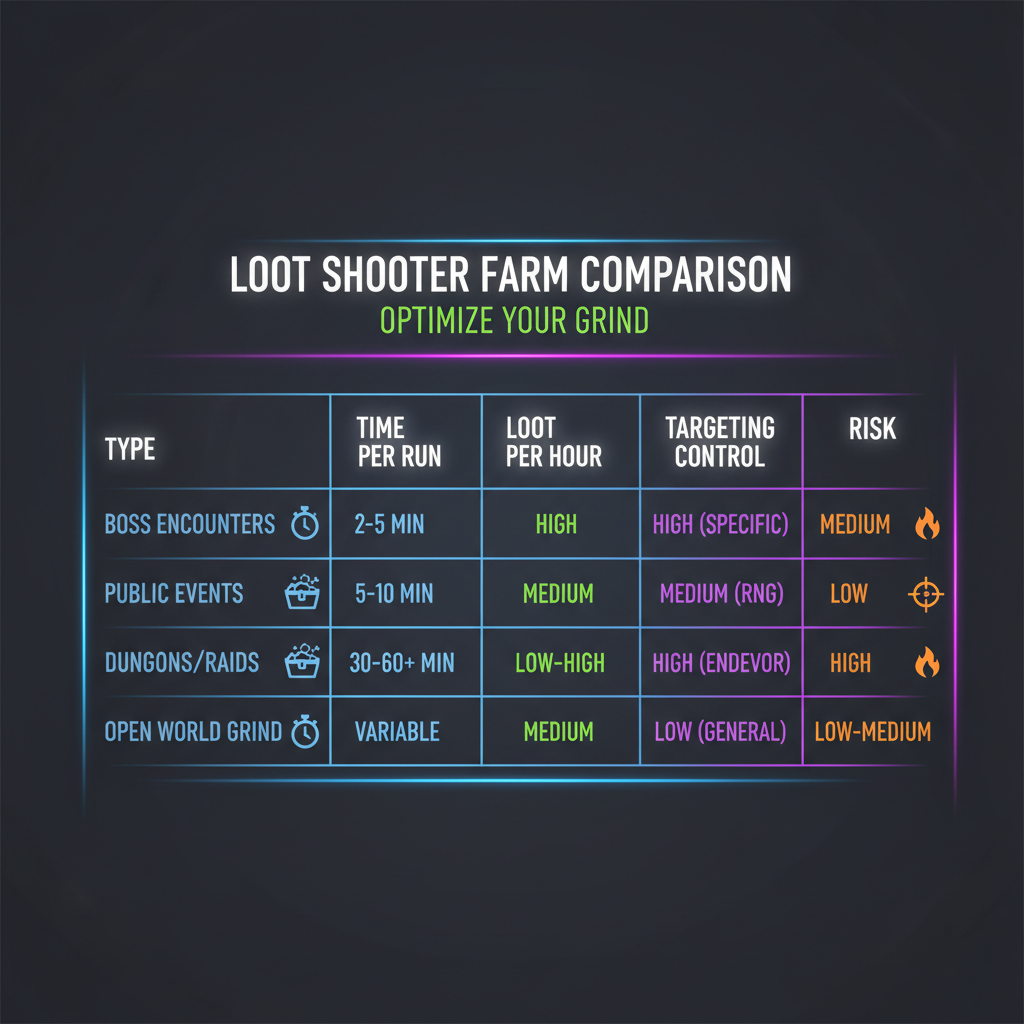
Quick comparison table: pick your farm in 30 seconds
Use this as a starting point, then adjust based on your clear speed and what your game’s current patch favors.
| Farm type | Typical run time | Best for | Targeting control | Common downside |
|---|---|---|---|---|
| Quick boss loop | 2–8 min | Uniques/legendaries, boss pools | Medium | Travel/reset overhead |
| Short dungeon/strike | 8–15 min | Consistent gearing, XP | Low–Medium | Unskippable time gates |
| Event circuit | Continuous | Currency, mats, broad loot | Low | Server/rotation variance |
| High-tier difficulty | 12–30+ min | High-roll stats, exclusives | Medium | Wipes kill efficiency |
| Targeted focusing/crafting | Varies | Specific slot fixes, perk chase | High | Costs, caps, lockouts |
Self-check: are you farming the right thing, or just busy?
If your results feel random in a bad way, run this quick checklist. It sounds basic, but it catches the usual mistakes.
- Your goal is specific: “a void SMG with reload + damage perk” beats “better loot.”
- You time your runs: if you do not know your average clear time, you cannot optimize.
- You have enough drop rolls per hour: more reward sources per run usually beats bigger single chests.
- Your inventory flow works: you can dismantle, stash, or mark items quickly without long breaks.
- You can repeat without burnout: the best theoretical farm that you hate running will not last.
If you check only one box, switch strategies. Many players chase best loot farms in looter shooters when what they really need is a tighter goal and a faster loop.
Practical farming routes you can apply in most looter shooters
Because each game names activities differently, think in routes. These are “portable” patterns that usually map cleanly to Destiny-style playlists, Borderlands-style boss farms, The Division-style missions, Warframe-style nodes, and similar systems.
Route A: 10-minute boss sandwich (fastest legendary attempts)
- Do one quick bounty/quest step on the way to a named target.
- Kill the boss, open the chest, check drops immediately.
- Reset via checkpoint, fast travel, or activity relaunch.
- Every 3–5 runs, spend your earned currency on focusing or vendor rolls.
This route shines when your build deletes a boss reliably and the reset is painless.
Route B: two short missions, then a targeted spend (steady upgrades)
- Queue two strike-length activities back-to-back to keep matchmaking time low.
- Pick the difficulty where you rarely wipe.
- Convert rewards into a targeted purchase or craft attempt.
It is less exciting than pure boss loops, but it tends to produce more “usable” items per hour.
Route C: open-world loop (currency + materials)
- Follow a fixed circuit of 4–6 event locations.
- Prioritize events with multiple chests or elite spawns.
- Bank materials on a timer, not after every drop.
When the world is active, this is where best loot farms in looter shooters can feel effortless, because you avoid constant loading and menu time.

Efficiency tips that usually matter more than “secret farms”
Most “hidden” farms get patched or become crowded. The habits below keep working even after balance changes.
- Lower difficulty if it improves clear speed: a 20% reward bump rarely beats a 40% time penalty.
- Optimize downtime: loadouts, dismantling, and vendor trips should happen in batches.
- Build for consistency: sustain and ammo economy often beat peak DPS for farming.
- Track a simple metric: runs per hour or reward rolls per hour, nothing fancy.
- Play the weekly/seasonal boosts: many games rotate bonuses that quietly change what is “best.”
According to Valve (Steam platform documentation and community guidelines), stable performance and reduced background load can improve gameplay experience; in farming terms, fewer stutters and faster loads can indirectly increase completions per hour.
Common mistakes to avoid (the stuff that wastes whole weekends)
These are the patterns that make players swear the game is “stingy,” even when the math is fine.
- Farming without targeting: if focusing exists, ignoring it usually means more junk.
- Chasing outdated YouTube routes: patch notes change drop tables and timers, sometimes quietly.
- Overcommitting to high difficulty: one wipe every run is a loot-per-hour disaster.
- Not learning the loot pool: some items simply cannot drop where you are farming.
- Burning out your team: if a farm needs four people, schedule shorter sessions and rotate roles.
If you feel stuck, shift your loop for a day. Even a small change can reset motivation, and motivation is a real resource in grind games.
When it makes sense to ask for help (or look up specifics)
General strategy gets you far, but some situations are genuinely hard to self-solve.
- You need a specific named drop and you are not sure which activity owns that loot pool.
- Your clear time is slow because of build issues, not mechanics, and you want a quick diagnostic.
- You keep hitting weekly lockouts or caps and do not know the best alternate loop.
- You are farming in a group and arguments start about “best” routes, a shared plan helps.
In those cases, checking the official help site, patch notes, or a well-moderated community resource often saves time. Stick to sources that update with patches, because looter shooters evolve constantly.
Conclusion: your “best” farm is the one you can repeat and measure
The fastest way to improve results is not hunting a mythical perfect spot, it is choosing a loop with short runs, enough reward rolls, and some kind of targeting. Once you time your clears and clean up downtime, the loot starts to feel a lot less random.
If you want one action step today, pick one activity you can finish in under 10 minutes, run it for an hour, and track completions. Then decide whether you need more speed, more targeting, or a different loot pool.
FAQ
What are the best loot farms in looter shooters if I only play solo?
Solo players usually do best with quick boss loops and short missions where wipes are unlikely. If matchmaking is slow in your region, open-world event circuits can outperform instanced content simply by cutting queue time.
Is higher difficulty always better for loot?
Not always. Higher tiers often improve quality or add exclusive drops, but if your completion time jumps too much, your loot per hour can drop. Many players get better results by farming a tier they can clear smoothly.
How do I target a specific weapon without wasting currency?
Set a budget per session and spend in batches, not after every run. If the system has focusing or crafting, read the costs carefully and confirm the item is actually in that pool before you commit.
Why does my friend get more drops than I do in the same runs?
RNG can look unfair in short samples, and some games also have different reward tracks, bonuses, or account states that affect outcomes. Over a longer session, track your completions and reward rolls rather than single “lucky” moments.
Should I farm bosses or missions for leveling?
For leveling, missions and event chains often win because they include completion XP plus lots of enemy XP. Boss-only loops can be good if the reset is extremely fast, but they can feel streaky.
How long should I farm before switching activities?
If you are not seeing progress after 45–90 minutes, it is usually smart to change either the loot pool or the targeting method. The break also helps avoid burnout, which is the silent killer of long grinds.
Do “secret” farms still exist, and are they worth it?
Sometimes, but they tend to be patched or nerfed. Treat them as a short-term bonus, not your main plan, and keep a stable baseline route so you are not stranded when the exploit disappears.
If you are trying to settle on a reliable loop and want a more tailored plan, it often helps to share your goal item, your average clear time, and whether you play solo or in a group, then you can map the most practical farm type without guessing.