
Best games with resource management survival are the ones that make every decision feel expensive, one more night in the cold, one more risky run for food, one more tool that breaks at the worst moment. If you love survival games but get bored when loot feels infinite, this list is built for you.
Resource management is where survival either clicks or falls apart. Good systems create tension without feeling unfair, bad systems just waste time. The difference matters, especially if you only have a few hours a week and want a game that respects your attention.
I’ll break down what “resource management” really means in practice, give a quick self-check to find your flavor of survival, and then recommend strong picks across solo, co-op, base-building, and narrative-heavy styles. No one game fits everyone, so the goal is to help you pick the right kind of pressure.
What counts as “resource management” in survival games
In most survival titles, “resources” aren’t just wood and stone. The real management layer is how the game forces trade-offs: weight limits, spoilage timers, fuel consumption, tool durability, injury risk, noise, temperature, and time itself.
If you want a quick mental model, I’d separate it into three buckets:
- Immediate needs: hunger, thirst, warmth, sleep, injuries.
- Production chain: gathering, crafting, refining, cooking, farming, automation.
- Strategic constraints: base location, storage, encumbrance, seasons, raids, permadeath rules.
Games land on different points of the spectrum. Some are “inventory math” heavy, others are “route planning” heavy, and a few lean on “social survival” where other players become the real scarce resource.
Quick self-check: which survival pressure do you actually enjoy?
Before buying anything, it helps to be honest about what you want to feel while playing. A lot of frustration comes from picking a game that’s great at a kind of stress you don’t like.
- You like calm optimization if you enjoy farming loops, storage layouts, production upgrades, and long-term planning.
- You like constant tension if you enjoy limited saves, scarce ammo, harsh weather, or permadeath-ish consequences.
- You like co-op logistics if you enjoy dividing roles, running supply routes, and building “systems” with friends.
- You like narrative survival if you prefer tough decisions, atmosphere, and “make it through this chapter” pacing.
Also worth asking: do you want complexity from rules (deep mechanics) or complexity from risk (punishing outcomes)? The best games with resource management survival can deliver either, but they feel very different.
Best games with resource management survival (by style)
Below are picks that tend to stand out because the resource loop creates meaningful choices, not just busywork. Availability can vary by platform, and some games shine more after you learn their “language,” so expect a ramp.
Harsh, skill-forward survival
- The Long Dark (solo): Cold management, calorie economy, limited tools, route planning. Great if you want quiet tension and hard trade-offs.
- Project Zomboid (solo/co-op): Food, fatigue, injuries, noise, base security, long-term planning in a zombie sandbox. Deep systems, slow burn.
Base-building and production chains
- RimWorld (solo): Not “first-person survival,” but one of the strongest resource + crisis sims. Your scarcity problems evolve into moral and logistical problems.
- Oxygen Not Included (solo): Resource management turned into engineering. Heat, oxygen, germs, power, and layout matter. Great if you enjoy problem-solving.
Co-op survival with strong logistics
- Don’t Starve Together (co-op): Seasonal planning, food preservation, sanity management, team roles. Very readable systems, deceptively demanding.
- Valheim (solo/co-op): Food as a build choice, stamina economy, progression via biomes. Resource runs feel like expeditions, not chores.
Sandbox crafting and long progression
- Green Hell (solo/co-op): Nutrition balance, injuries, infections, navigation. It can be punishing, but the “body management” layer feels distinct.
- Subnautica (solo): Inventory pressure, base placement, oxygen constraints, and exploration risk. Less grindy than many, very focused loop.
Multiplayer threat and territory
- Rust (multiplayer): Scarcity is partly social. Resource management includes raid risk, base upkeep, and timing. High intensity, not for everyone.
Comparison table: pick the right game fast
If you’re deciding between a few, this quick table usually saves time. “Complexity” here means how many interlocking systems you must learn to feel competent.
| Game | Best for | Resource pressure feels like | Co-op | Complexity |
|---|---|---|---|---|
| The Long Dark | Atmospheric solo survival | Cold, calories, navigation | No (main mode) | Medium |
| Project Zomboid | Long-run planning | Time, noise, injuries, supplies | Yes | High |
| Don’t Starve Together | Co-op roles and seasons | Season timers, food loops | Yes | Medium |
| Valheim | Exploration + building | Expeditions, crafting tiers | Yes | Medium |
| Oxygen Not Included | Systems/engineering fans | Oxygen, heat, power grid | No | Very high |
| Subnautica | Exploration survival | Oxygen, depth risk, inventory | No | Medium |
| Green Hell | Realistic survival stress | Nutrition, illness, wounds | Yes | Medium |
| Rust | High-stakes multiplayer | Players, raids, upkeep timers | Yes | High |
How to get into resource management survival without burning out
Many people bounce off these games because they treat the early hours like a test. A better approach is to set “survival rules” for yourself so the learning curve feels fair.
Practical setup tips (works for most games)
- Start with a short loop: secure water/food, establish a safe shelter, then expand. Don’t chase “perfect base” on day one.
- Choose one constraint to master: temperature, food, or combat. When that stabilizes, the rest gets easier fast.
- Overbuild storage early: inventory friction is a silent fun-killer, and many titles are designed around sorting.
- Use the map like a budget: mark reliable nodes and plan runs with a purpose, not random wandering.
Key takeaway checklist
- You’re ready to progress when you can survive a “bad day” (storm, injury, surprise fight) without resetting.
- You’re grinding when you keep collecting materials with no clear next unlock or build target.
- Your difficulty is off if you spend most sessions recovering from one mistake instead of making new decisions.
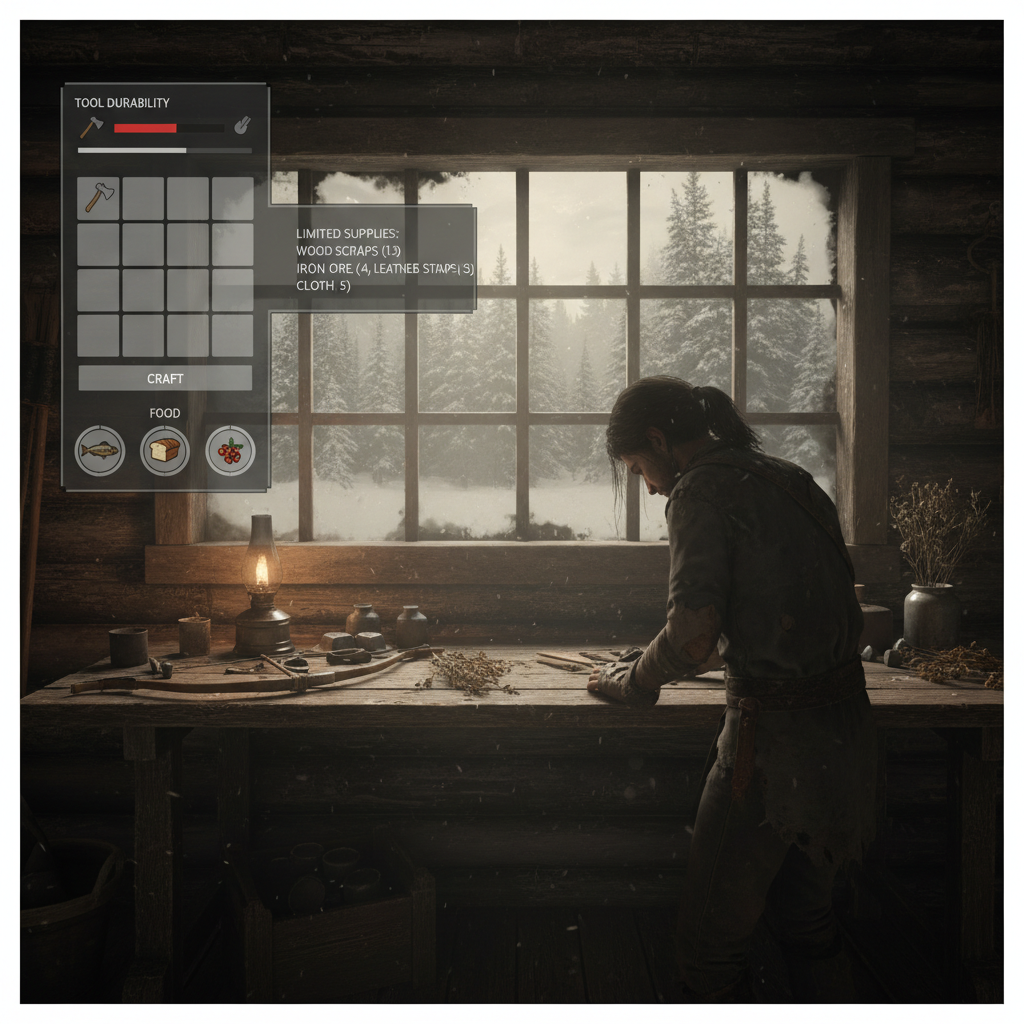
Common mistakes that make survival resource systems feel “unfair”
A lot of pain comes from habits carried over from action games or open-world looters. Resource management survival punishes vague plans.
- Hoarding without upgrading: stockpiles feel safe, but many games expect you to turn resources into tools, insulation, farms, or better mobility.
- Ignoring weight and repair costs: that “one more item” often costs stamina, time, and risk on the way home.
- Underestimating travel time: nightfall, weather shifts, or fatigue timers turn “a quick trip” into a chain of losses.
- Copying meta builds too early: guides assume comfort with systems. Early on, your best strategy is stability, not efficiency.
According to PEGI, video games can include content and mechanics that may impact different players in different ways, so checking ratings and content descriptors is a practical step if you’re sensitive to stress, violence, or online interactions.
When to tweak settings or look for help
Some players treat difficulty settings like “cheating,” but in this genre, settings are often part of the design. If you want the management puzzle without the constant punishment, adjusting sliders can be the difference between quitting and actually learning the systems.
- Lower loss penalties if dying means hours of recovery, and you’re not enjoying that loop.
- Increase resource abundance slightly if you’re stuck before you can access core crafting tiers, which is common in certain starts.
- Use co-op if logistics overwhelms you, splitting roles makes complex games feel readable.
If you’re dealing with compulsive play patterns or stress that spills into daily life, it may help to talk with a qualified professional. According to NIMH, mental health concerns are common and treatable, and getting support can be a solid, practical move.
Conclusion: how to choose your next survival game
The best games with resource management survival aren’t “the hardest,” they’re the ones where scarcity creates interesting choices and you can feel your decision-making improve. If you want pure atmosphere and tough trade-offs, start with The Long Dark. If you want deep long-term planning and emergent stories, Project Zomboid or RimWorld usually fits. If you want co-op logistics with steady progression, Don’t Starve Together and Valheim stay popular for a reason.
Action step: pick one game from a category that matches your stress tolerance, then commit to a simple goal for your first two sessions, “stable food and shelter” beats “big base” almost every time.
FAQ
What are the best games with resource management survival for beginners?
Valheim and Subnautica often feel approachable because progression is clear and the learning curve ramps. You still manage resources, but the game usually teaches by nudging, not punishing.
Which survival game has the deepest resource management?
If you mean interconnected systems, Oxygen Not Included is hard to beat. If you mean “everything matters over weeks of in-game time,” Project Zomboid tends to deliver that slow, demanding pressure.
Are there good co-op options that don’t feel too sweaty?
Don’t Starve Together can be challenging, but co-op roles reduce stress, one person farms while another explores. Valheim also works well for mixed-skill groups because building and gathering always contribute.
Do resource management survival games require a lot of grinding?
Some do, especially sandbox PvP titles, but many single-player games focus more on planning than raw hours. If you feel stuck grinding, it’s often a sign to change goals, relocate, or adjust difficulty.
What should I prioritize first in most survival games?
Stability: a safe place to reset, a reliable food or water loop, and one “upgrade path” such as better tools or insulation. Once those are in place, exploration stops feeling like a coin flip.
Is permadeath necessary for the genre to feel good?
Not really. Permadeath increases tension, but it also increases frustration for some players. Many of the best games with resource management survival offer modes that keep the planning challenge without wiping your progress.
How do I know if a game is more combat-focused than management-focused?
Look for signs like frequent enemy waves, raid timers, and heavy weapon crafting. Management-forward games usually emphasize weather, travel, storage, and production chains as the main obstacles.
If you’re trying to find a survival game that actually matches your time budget, play style, and tolerance for punishment, it can help to narrow choices by one constraint you enjoy most, weather, logistics, engineering, or social risk, then build your shortlist around that.